
Condense an If-Else Statement into One Line
If your if-else statement is short and simple, you can condense it into one line for readability.

If your if-else statement is short and simple, you can condense it into one line for readability.

It is common to use the if-else statements to execute multiple conditional statements.
In Python 3.10 and above, you can use the switch statement to do the same thing.
With the switch statement, you don’t need to repeat the same statements multiple times (food==x), which makes the code cleaner than using multiple if-else statements.

If you want to check whether two file paths are the same, use Path.samefile().

If you want to get a list of random elements from a specific list, use random.choices. This method also allows you to weigh the possibility for each value with the weights parameter.
In the code above, I use random.choices to get a list of 10 random values. 0 is two times more likely to be selected than 1 and is ten times more likely to be selected than 2.
random.choices: Get Weighted Random Choices From a Python List Read More »

In Python, you can compare and subtract dates using operators.
Use Comparison and Arithmetic Operators on Dates in Python Read More »

dict.pop allows you to remove and return an item with the matching key from a dictionary. If a key doesn’t exist, you will get a KeyError.
To avoid this error, add a default value to the second argument of dict.pop.
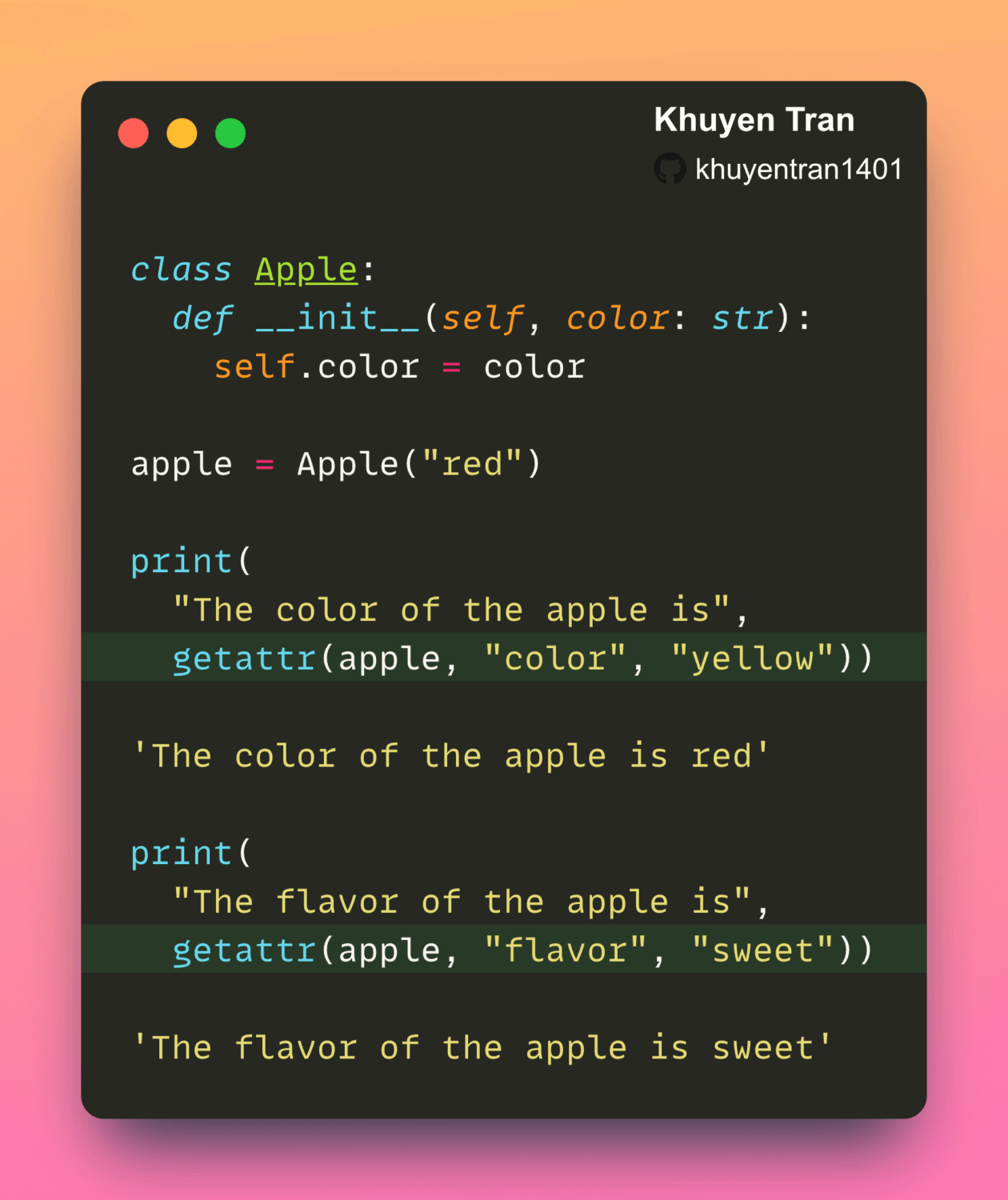
The getattr(class, attribute_name) method gets the value of an attribute of a class. However, if the attribute is not found in a class, it returns the default value provided to the function.
getattr: a Better Way to Get the Attribute of a Class Read More »

If you want to combine multiple dictionaries into one unit, collections.ChainMap is a good option. ChainMap allows you to organize and get the keys or values across different dictionaries.
ChainMap: Combine Multiple Dictionaries into One Unit Read More »

If you want to do calculations inside a Python string, use f-string.
