Generic selectors
Exact matches only
Search in title
Search in content
Post Type Selectors
Filter by Categories
About Article
Analyze Data
Archive
Best Practices
Better Outputs
Blog
Code Optimization
Code Quality
Command Line
Course
Daily tips
Dashboard
Data Analysis & Manipulation
Data Engineer
Data Visualization
DataFrame
Delta Lake
DevOps
DuckDB
Environment Management
Feature Engineer
Git
Jupyter Notebook
LLM
LLM Tools
Machine Learning
Machine Learning & AI
Machine Learning Tools
Manage Data
MLOps
Natural Language Processing
Newsletter Archive
NumPy
Pandas
Polars
PySpark
Python Helpers
Python Tips
Python Utilities
Scrape Data
SQL
Testing
Time Series
Tools
Visualization
Visualization & Reporting
Workflow & Automation
Workflow Automation

Pandas

DuckDB + PyArrow: 2900x Faster Than pandas for Large Dataset Processing

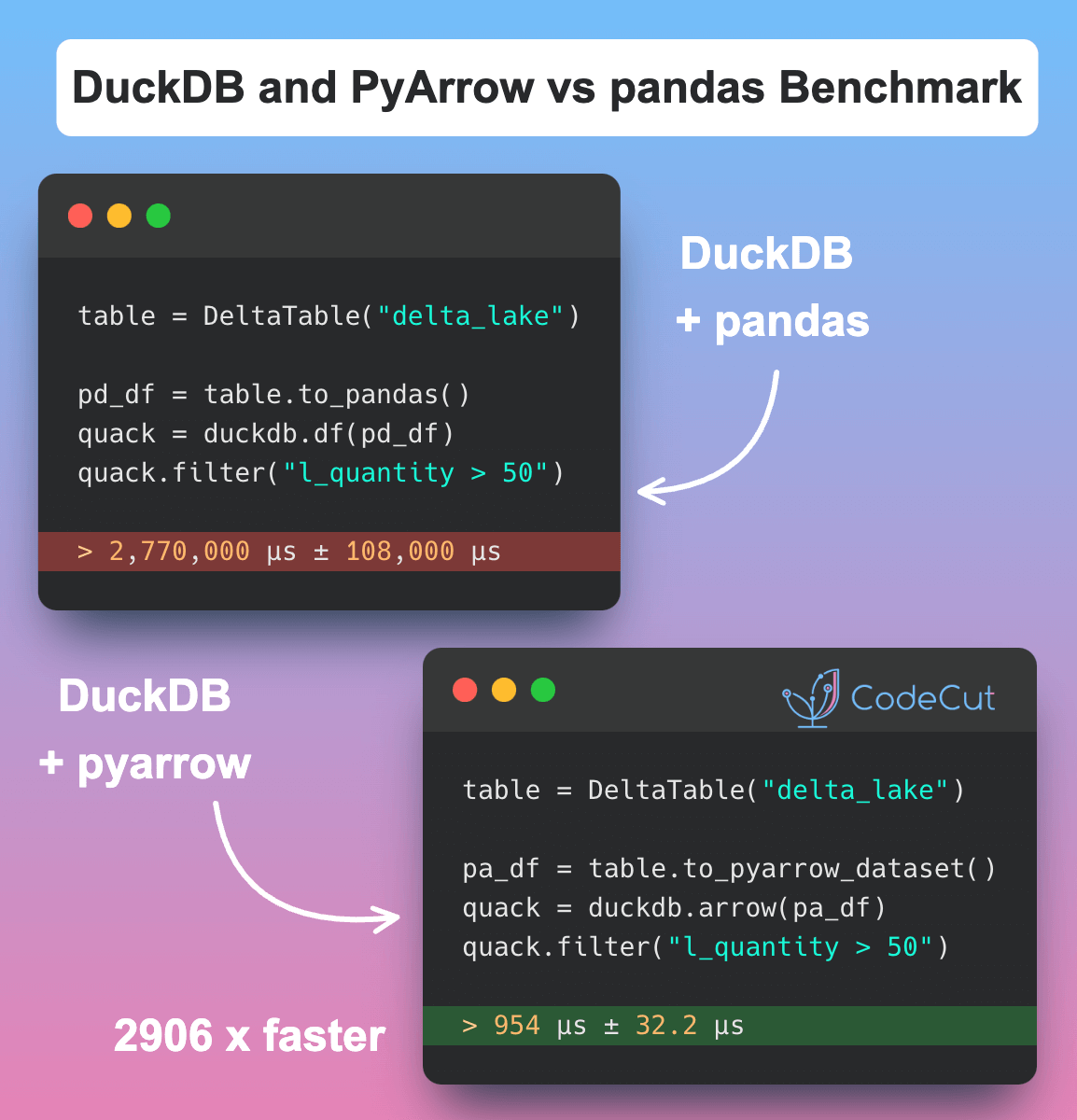
DuckDB optimizes query execution with multiple optimizations, while PyArrow efficiently manages in-memory data processing and storage. Combining DuckDB and PyArrow allows you to efficiently process datasets larger than memory on a single machine.

In the code above, we convert a Delta Lake table with over 6 million rows to a pandas DataFrame and a PyArrow dataset, which are then used by DuckDB.

Running DuckDB on a PyArrow dataset is approximately 2906 times faster than running DuckDB on a pandas DataFrame.

DuckDB + PyArrow: 2900x Faster Than pandas for Large Dataset Processing Read More »
Efficient String Data Handling in pandas 2.0 with PyArrow Arrays

As of pandas 2.0, data in pandas can be stored in PyArrow arrays in addition to NumPy arrays. PyArrow arrays provide a wide range of data types compared to NumPy.

One significant advantage of PyArrow arrays is their string datatype, which offers superior speed and memory efficiency than storing strings using object types.

Full code.

Efficient String Data Handling in pandas 2.0 with PyArrow Arrays Read More »

Enhancing Data Handling with scikit-learn’s DataFrame Support

By default, scikit-learn transformers return a NumPy array. This can pose a challenge if a pandas DataFrame is required for subsequent data processing steps.

Luckily, as of scikit-learn version 1.3.2, you can use the set_output method to obtain the results as a pandas DataFrame.

This method is not limited to individual transformers but can also be applied within a scikit-learn pipeline.

Enhancing Data Handling with scikit-learn’s DataFrame Support Read More »

Scroll to Top

Work with Khuyen Tran

Work with Khuyen Tran